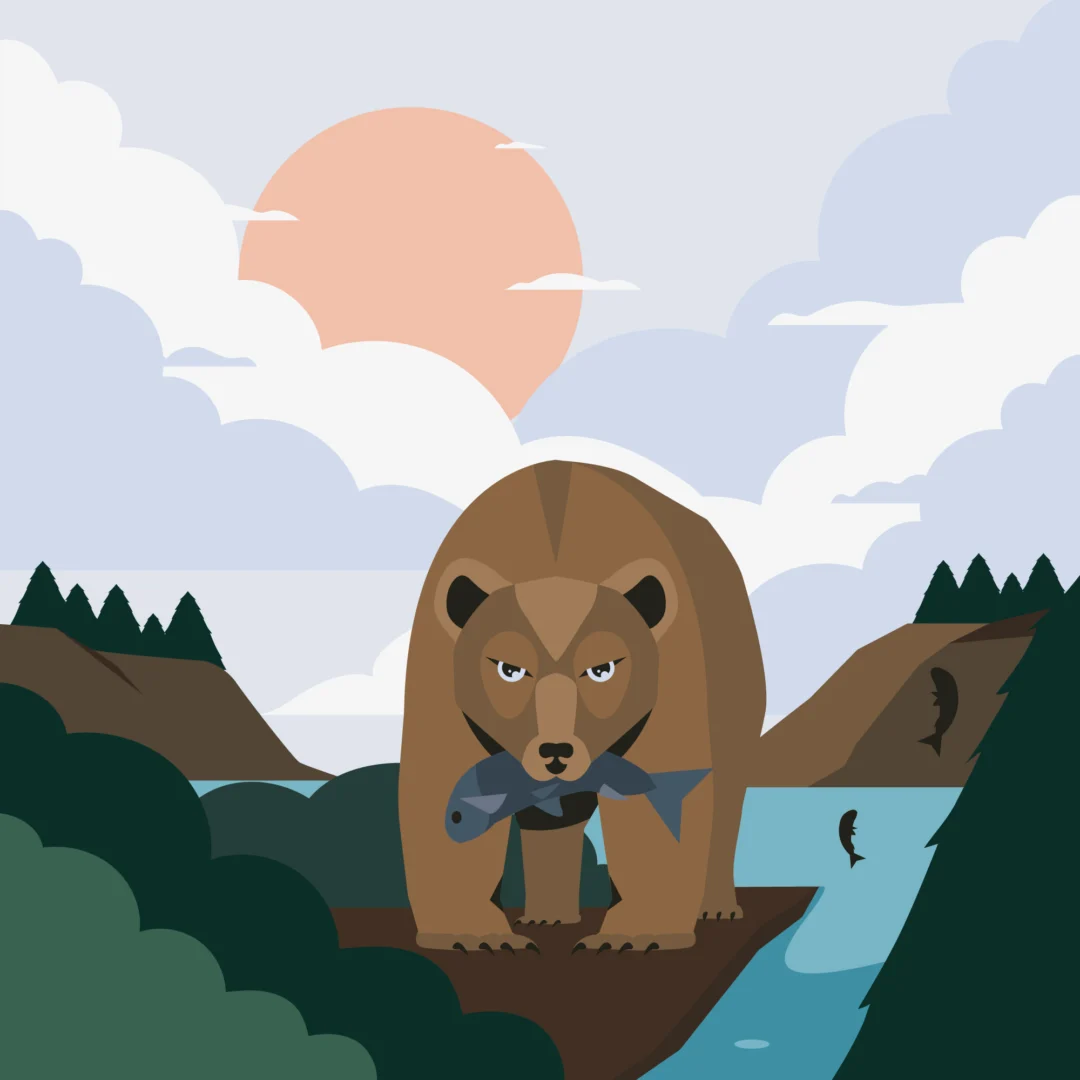
Every autumn, people around the world vote for the fattest bear in Katmai National Park, a huge wild park in southwestern Alaska. This year, the winner is Bear 89, a big brown bear that park rangers call Backpack.
Backpack won the final round of Fat Bear Week on Tuesday, September 29. He got 103,334 votes. His rival, a female bear known as Bear 910, got 98,253. That is a difference of only about 5,000 votes.
The contest started in 2014. All the bears in it live near the Brooks River, where thousands of sockeye salmon swim upstream every summer. The bears wait in the water and at the top of a small waterfall called Brooks Falls, and they catch the fish as they jump. Anyone can watch them on free live webcams and then vote online. This year, 16 bears took part, four more than last year, and people cast about 2.5 million votes from more than 100 countries.
The bears need all that fat. They spend most of the winter in their dens, in a long, deep sleep called hibernation, and they eat almost nothing during that time. The fat they put on in summer and fall keeps them alive until spring. An adult male can weigh about 270 kilograms (600 pounds) in early summer and more than 450 kilograms (1,000 pounds) by the fall.
Backpack is about 20 years old. He got his name as a cub, when he liked to climb onto his mother’s back while she swam across the river. His mother, a bear called Holly, won Fat Bear Week herself in 2019.
In 2007, when he was about a year old, Backpack hurt one of his front legs and could not put any weight on it. Rangers worried that he would not live through the summer. Holly stayed close to him, and by September, his leg had healed, the National Park Service says.
Today, he is one of the biggest bears on the river, but he rarely fights. His size and calm manner are usually enough to make other bears keep their distance. Park officials have called him a “gentle giant.”
Rangers counted 37 cubs along the Brooks River this year, a record. “There are more cubs at Brooks Camp this year than have been seen in a long time,” said Mark Sturm, the park’s superintendent. In October or November, when the salmon are gone, Backpack and his neighbours will go into their dens for the winter.
Sources: CBS News, NPR, National Park Service, Popular Science, The Weather Channel, KTUU
Alaska’s most closely watched popularity contest has a new champion, and he is a heavyweight in every sense. Bear 89, better known as Backpack, won Fat Bear Week 2026 on Tuesday, September 29, edging out Bear 910, an adult female, by 103,334 votes to 98,253 in a final that went down to the wire.
The contest is run by Katmai National Park and Preserve, a vast stretch of wilderness in southwestern Alaska that covers roughly 17,000 square kilometres (4.2 million acres) and is home to about 2,200 brown bears. Since 2014, park staff have chosen a handful of the bears that fish the Brooks River and set them against each other in a knockout bracket. Viewers follow them on live webcams as they gorge on sockeye salmon, then vote online for the one that looks most impressively padded. This year the field grew from 12 bears to 16, and fans cast about 2.5 million votes from more than 100 countries, up from roughly 1.7 million last year.
Behind the fun lies some serious biology. Brown bears go without food for months while they hibernate, living off the fat they pile on over the summer and early autumn. An adult male weighing around 270 kilograms (600 pounds) in early summer can top 450 kilograms (1,000 pounds) by the fall. Every extra kilogram is, in effect, stored fuel for the long Alaskan winter.
Backpack, now about 20, owes his nickname to a habit he had as a cub of clambering onto the back of his mother, Holly, as she swam through the river. Holly is Fat Bear Week royalty in her own right, having taken the title in 2019. Her son now succeeds Bear 32, known as Chunk, who won last year.
Rangers once doubted Backpack would make it to adulthood. In the spring of 2007, when he was about a year old, he emerged from the den with a front leg so badly hurt that he could not put any weight on it. Holly kept him close, and by September the leg had healed, according to the National Park Service.
These days he is among the largest bears on the river, yet he has a reputation for keeping out of trouble. Rather than throwing his weight around, he relies on sheer size and a calm temperament to keep rivals at bay, which has led park officials to call him a “gentle giant.”
The 2026 season stood out for another reason. Rangers counted 37 cubs along the Brooks River, a record, and park superintendent Mark Sturm noted that there were “more cubs at Brooks Camp this year than have been seen in a long time.” Once the salmon runs taper off in October or November, Backpack and his neighbours will retreat to their dens to sleep off their summer feast.
Sources: CBS News, NPR, National Park Service, Popular Science, The Weather Channel, KTUU