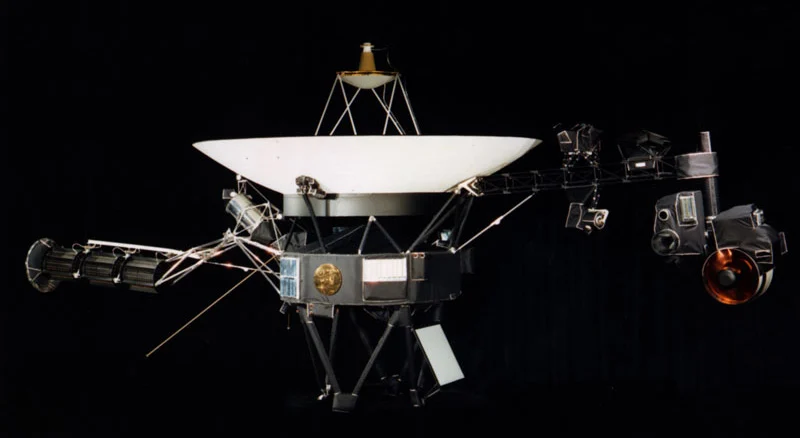
On Wednesday, November 18, at 5:16 a.m. Eastern time, NASA’s Voyager 1 is expected to become the first spacecraft ever to travel one light-day away from Earth.
A light-day is a distance, not a time. It is how far light travels in 24 hours: about 25.9 billion kilometres (16.1 billion miles). Light from the sun reaches Earth in about eight minutes, so this is very, very far. Voyager 1 is still moving away from us at about 61,000 kilometres (38,000 miles) per hour.
The spacecraft left Earth in 1977. In its early years, it flew past Jupiter and Saturn and sent home close-up pictures of them. It helped scientists discover active volcanoes on Io, one of Jupiter’s moons, the first ones ever found beyond Earth. In 1990, it turned its camera back and took a famous photo of Earth as a tiny “pale blue dot.” Then, in 2012, it left the heliosphere, a giant bubble around the sun and its planets, and entered the space between the stars.
At this distance, talking to Voyager 1 takes patience. A message from Earth needs about a day to reach the spacecraft, and its answer needs another day to come back. “You wait two days before you finally get a response,” said Suzanne Dodd, the Voyager project manager at NASA’s Jet Propulsion Laboratory (JPL) in California. The data also arrives very slowly, much more slowly than the internet in our homes.
Last month, the team had a scare. On October 18 and 19, NASA tried to contact Voyager 1 and heard nothing back. The signal finally returned on October 20. Engineers found that one set of thrusters, the small engines that keep the spacecraft’s antenna pointed at Earth, had stopped working, and Voyager 1 had switched to its backup thrusters by itself. They still do not know why contact was lost. “We’re relieved to be back in contact with Voyager 1,” said Kareem Badaruddin, the mission manager at JPL.
Voyager 1 is also running out of power. Its nuclear power source gets weaker every year, so the team has turned off some instruments to save energy. No one can travel to the spacecraft to fix it, so engineers send it instructions by radio from Earth. In September, they told it to use three spare parts that need less power. Without this change, they might have had to turn off another instrument as early as summer 2027. Scientists expect its power to run out in about 10 to 15 years.
Even after it goes quiet, Voyager 1 will keep flying. It carries a Golden Record, a disc with sounds and pictures from Earth, in case anyone ever finds it. “The Voyagers become our silent ambassadors, a little bit of us that continues into space,” said Linda Spilker, the mission’s project scientist.
Image: NASA/JPL-Caltech
Sources: NASA, Science News, CNN
At 5:16 a.m. Eastern time on Wednesday, November 18, NASA’s Voyager 1 is expected to become the first spacecraft to reach one light-day from Earth, more than 49 years after it was launched.
A light-day measures distance, not time. It is how far light travels in 24 hours: roughly 25.9 billion kilometres (16.1 billion miles). Sunlight, by comparison, reaches Earth in about eight minutes. Voyager 1 is still pulling away at about 61,000 km/h (38,000 mph). Its twin, Voyager 2, will not reach the same distance until November 2035.
In its early years, the probe flew past Jupiter and Saturn. Images it took while looking back at Jupiter showed a plume rising about 250 kilometres above Io, one of Jupiter’s moons. It was the first active volcano ever found beyond Earth. In 1990, at the urging of astronomer Carl Sagan, the team turned the camera around for one last look at the planets and captured the famous image of Earth as a “pale blue dot.” Then, on August 25, 2012, Voyager 1 left the heliosphere, the giant bubble the sun creates around itself and its planets, and entered the space between the stars.
Engineers talk to the spacecraft by radio, through the giant antennas of NASA’s Deep Space Network at three sites on Earth. Each message needs about a day to arrive, and the reply needs another day to come back. “If you want to say ‘hello’ to Voyager, you send your message and then you go home and you wait two days before you finally get a response,” said Suzanne Dodd, the Voyager project manager at NASA’s Jet Propulsion Laboratory (JPL) in California.
In October, the team had a scare. On October 18, NASA’s antennas tried to make contact with Voyager 1 at a planned time, but they could not pick up any signal. A second try 24 hours later also failed. The signal returned on October 20. One set of thrusters, the small engines that keep the spacecraft’s antenna pointed at Earth, had stopped working, and Voyager 1 had switched to its backups on its own. The cause of the silence is still unknown. “This is the first time we’ve seen the spacecraft do something like this,” said Kareem Badaruddin, the mission manager at JPL. “We’re relieved to be back in contact with Voyager 1 and are eager to understand what happened.”
The bigger long-term worry is power. Voyager 1’s nuclear power source produces about 4 watts less every year, so the team has already turned off some instruments. In early September, engineers carried out an operation nicknamed the “Big Bang,” which took months to prepare. Using radio commands, they swapped three devices that help keep the inside of the spacecraft warm for three others already on board that use less electricity. All three had to be swapped at the same time so that the heat stayed evenly spread. Without the swap, NASA might have had to shut down another of Voyager 1’s instruments as early as summer 2027. Even so, scientists expect its power to run out in 10 to 15 years.
When that happens, Voyager 1 will go quiet but keep flying. It carries a Golden Record, a disc with sounds and pictures from Earth, in case anyone ever finds it. “The Voyagers become our silent ambassadors, a little bit of us that continues into space,” said Linda Spilker, the mission’s project scientist. In her view, the spacecraft “may well outlast humanity.”
Image: NASA/JPL-Caltech
Sources: NASA, Science News