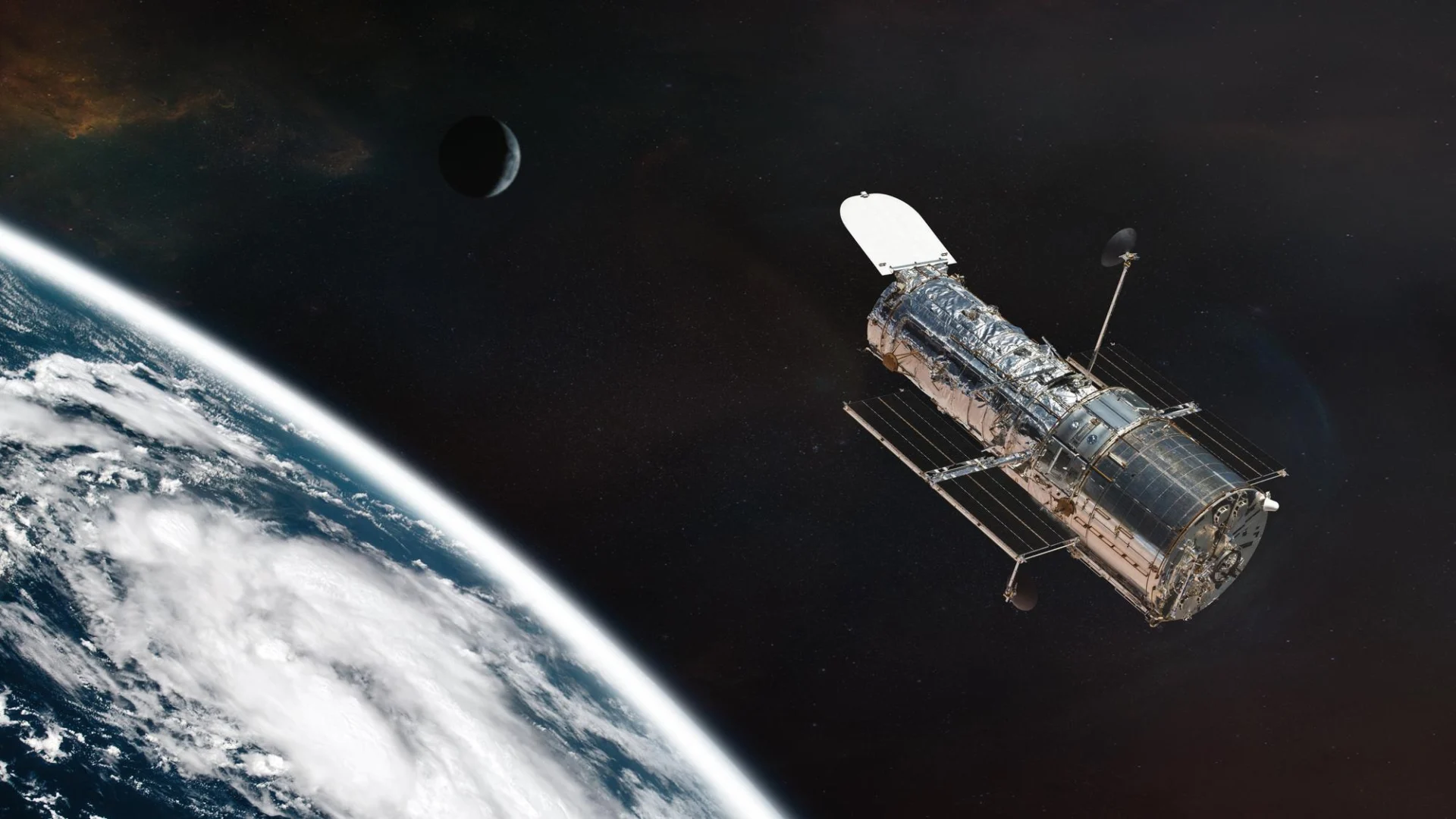
NASA’s Hubble Space Telescope, a large telescope that circles Earth high above the clouds, has reached a big milestone. On September 19, it finished its 200,000th trip around our planet.
Hubble went into space in April 1990, on the space shuttle Discovery. Because it works above the air, which makes stars look blurry from the ground, it can take very clear pictures of the universe. Engineers planned for it to work for about 15 years. More than 36 years later, it is still busy.
Hubble moves at about 27,000 kilometres per hour (17,000 miles per hour). One trip around Earth takes about an hour and a half, so it goes around the planet about 15 times a day. In total, it has travelled more than 8 billion kilometres (5 billion miles), over 50 times the distance from Earth to the Sun. Along the way, it has made more than 1.7 million observations.
The telescope had a rough start. Soon after the launch, scientists saw that its main mirror had a tiny mistake in its shape, and the first pictures were blurry. In 1993, astronauts flew up on a space shuttle and fixed the problem. Shuttle crews went back four more times, in 1997, 1999, 2002, and 2009. On these trips, they put in new cameras and changed parts that had stopped working well.
Over the years, Hubble has studied the air on planets that circle other stars. Its work also helped scientists discover dark energy. Nobody knows exactly what dark energy is, but it is making the universe grow faster and faster. After so many discoveries, scientists still want to use Hubble as much as they can. Each year, astronomers ask for about seven times more observing time than it can give, so most of their requests are turned down.
To mark the 200,000th trip, NASA shared a picture of what Hubble was looking at that day: a huge group of galaxies called MACS J0417. Far behind this group, a star exploded long ago. NASA’s newer telescope, the James Webb Space Telescope, spotted this explosion in 2025, and scientists named it Athena. The group of galaxies is so heavy that its gravity bends light, a little like a giant magnifying glass. Light from Athena reaches us along different paths, and some paths are longer than others. Because of this, the same explosion can appear more than once, months or even years apart. Scientists expect Athena to appear again before early March 2027, and Hubble is watching for it. The time between the two appearances will help them measure how fast the universe is growing.
Hubble will not last forever. The space shuttles stopped flying in 2011, so no astronauts can travel up to fix it anymore. Some of its gyroscopes, the parts that keep it pointing steadily at its targets, have worn out. Since 2024, Hubble has worked with just one, keeping another as a spare. At the same time, the very thin air at its height is slowly pulling it lower. Experts expect it to fall back into Earth’s atmosphere sometime in the mid-2030s.
Sources: NASA, Space.com
Somewhere above our heads, a 36-year-old telescope has just passed a milestone few machines in orbit ever reach. On September 19, NASA’s Hubble Space Telescope completed its 200,000th lap of Earth, still taking pictures more than two decades after it was expected to retire.
Hubble was carried into orbit by the space shuttle Discovery in April 1990, with a design life of around 15 years. Named after the American astronomer Edwin Hubble, it works above the atmosphere, which blurs and filters starlight before it reaches telescopes on the ground. Racing along at roughly 27,000 kilometres per hour (17,000 miles per hour), it circles the planet every 95 minutes or so. Over its lifetime, it has covered more than 8 billion kilometres (5 billion miles) and made upwards of 1.7 million observations.
Its career very nearly got off on the wrong foot. Within two months of launch, engineers discovered that the telescope’s main mirror had been ground to a slightly wrong shape, an error about one-fiftieth the width of a human hair, but enough to leave its first images frustratingly fuzzy. In 1993, a shuttle crew fitted Hubble with corrective optics, in effect a pair of glasses. Astronauts returned in 1997, 1999, 2002, and 2009 to swap out aging hardware and install sharper cameras.
Once it could see clearly, Hubble went on to analyze the atmospheres of planets orbiting distant stars and played a key part in the discovery of dark energy, the mysterious phenomenon driving the universe to expand ever faster. Demand for its time shows no sign of fading: astronomers request about seven times more observing time than the telescope can offer each year.
To mark the occasion, NASA released an image of what Hubble was studying on the day of its 200,000th orbit: MACS J0417, a massive cluster of galaxies. The cluster’s gravity is strong enough to bend and magnify the light of objects far behind it, an effect known as gravitational lensing. One of those background objects is Athena, an exploding star first spotted in 2025 by NASA’s James Webb Space Telescope. Because light from Athena travels to us along several routes of different lengths, the same explosion can show up more than once, months or even years apart. Scientists predict another appearance before early March 2027, and Hubble is keeping watch. Timing the delay will help refine the Hubble constant, the rate at which the universe is expanding, a measurement that has long been one of the telescope’s signature tasks.
For all its staying power, Hubble is living on borrowed time. With the shuttle fleet retired in 2011, there is no way to send astronauts up for repairs. Several of the gyroscopes that keep the telescope pointed steadily at its targets have failed, and since 2024 it has operated on just one, with another held in reserve. Meanwhile, faint traces of atmosphere at its altitude are gradually dragging it downward, and experts expect Hubble to re-enter Earth’s atmosphere sometime in the mid-2030s.
Sources: NASA, Space.com