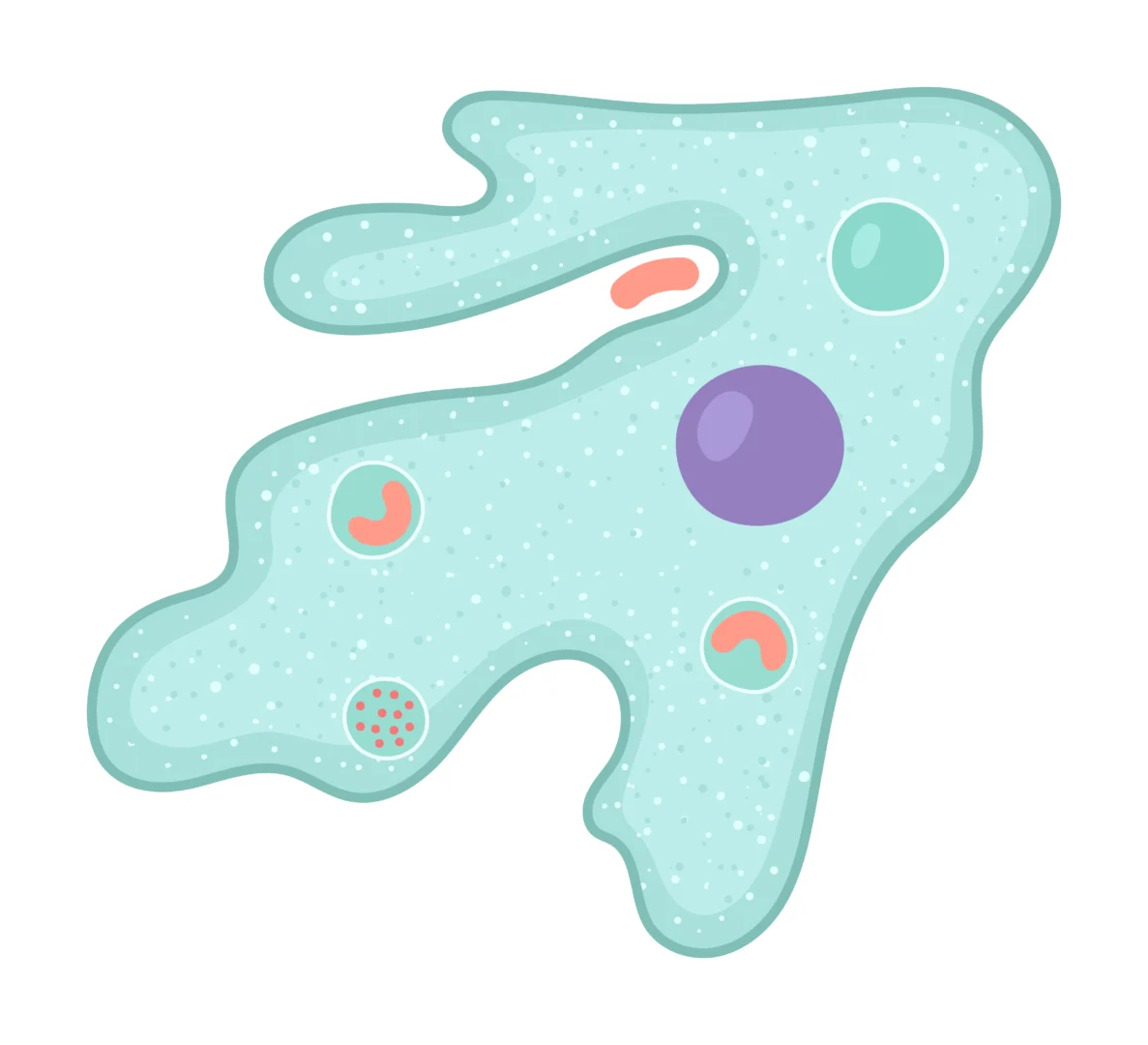
In a hot stream in northern California, scientists have found a tiny creature that can live in water hot enough to burn human skin. It is a type of amoeba, and the scientists have nicknamed it the “fire amoeba.”
Amoebas are made of a single cell. They are far too small to see without a microscope, and they move around by changing their shape. This one came from Lassen Volcanic National Park, an area of volcanoes and hot springs. The researchers collected water there in small bottles, which they held with barbecue tongs. The amoeba’s scientific name is Incendiamoeba cascadensis, which means “fire amoeba of the Cascades,” the mountain range where the park is.
Back in the lab, the team kept the amoebas in incubators, machines that hold samples at an exact temperature, and slowly turned up the heat. The amoebas kept dividing to make new cells at 63 degrees Celsius (145 degrees Fahrenheit). They could still move at 64°C (147°F), and they could survive for a short time at up to 70°C (158°F). For comparison, a hot bath is usually around 40°C (104°F).
The results surprised the scientists. “We definitely had to go back and check to make sure that our incubators were calibrated correctly,” said Beryl Rappaport, a PhD student at Syracuse University who led the study.
Some bacteria can live in even hotter water, but the fire amoeba is special for a different reason. Bacteria have very simple cells. Plants, animals, fungi, and people have more complex cells, with a nucleus, a small part inside the cell that holds its DNA. Amoebas have this kind of cell too. Until now, scientists had never seen a complex cell multiply above 60°C (140°F). The fire amoeba beat that limit by three degrees.
Three degrees may not sound like much. But Angela Oliverio, a microbiologist on the team, said the size of the jump was not the main point. What matters is the proof that complex cells can live at these temperatures, which means complex life is tougher than experts believed.
The study was published on September 22 in the science journal Cell. The discovery could also help in the search for life on other planets and moons. If complex cells can live in such hot places on Earth, scientists may need to look in more places in space, too.
Sources: NPR, Smithsonian Magazine, Live Science
Barbecue tongs are not standard scientific equipment, but they came in handy for a team of researchers dipping sample bottles into a scalding stream in northern California. What they pulled out was a single-celled organism that has rewritten the rule book on how much heat complex life can endure.
The newly described species, Incendiamoeba cascadensis, or “fire amoeba of the Cascades,” was found in a hot stream in Lassen Volcanic National Park, part of the Cascade mountain range. Its discovery was reported on September 22 in the journal Cell.
In the lab, the team began culturing the amoeba at 57 degrees Celsius (135 degrees Fahrenheit), the previous record for an amoeba, and found it thriving. So they kept turning up the heat. The organism went on dividing at 63°C (145°F), kept moving at 64°C (147°F), and could tolerate brief exposure to 70°C (158°F) before finally succumbing at around 80°C (176°F). Using heated microscopes, the researchers were able to watch individual cells split in two at temperatures that would scald human skin within seconds.
“I was very surprised,” said Beryl Rappaport, the Syracuse University PhD student who led the study. “We definitely had to go back and check to make sure that our incubators were calibrated correctly.”
The significance lies in what kind of organism this is. Heat-loving bacteria and archaea are nothing new; one microbe, Methanopyrus kandleri, can survive at a staggering 122°C (252°F). But those are prokaryotes, simple cells without a nucleus. The fire amoeba is a eukaryote, belonging to the same broad branch of life as plants, animals, fungi, and humans, whose cells keep their DNA inside a membrane-bound nucleus and contain specialized structures such as mitochondria. Until now, no eukaryote had been shown to reproduce above 60°C (140°F), a ceiling previously shared by certain fungi and red algae.
Three degrees might seem like a modest margin, but the team insists the number is beside the point. “It wasn’t so much the incremental amount that this record was broken by, as much as the proof that it was possible,” said Angela Oliverio, a microbiologist at Syracuse who co-authored the study.
The findings could ripple well beyond biology textbooks. If complex cells can cope with conditions once thought impossible, the range of places where life might exist, on Earth and perhaps on other worlds, may be wider than scientists assumed.
Sources: NPR, Smithsonian Magazine, Live Science