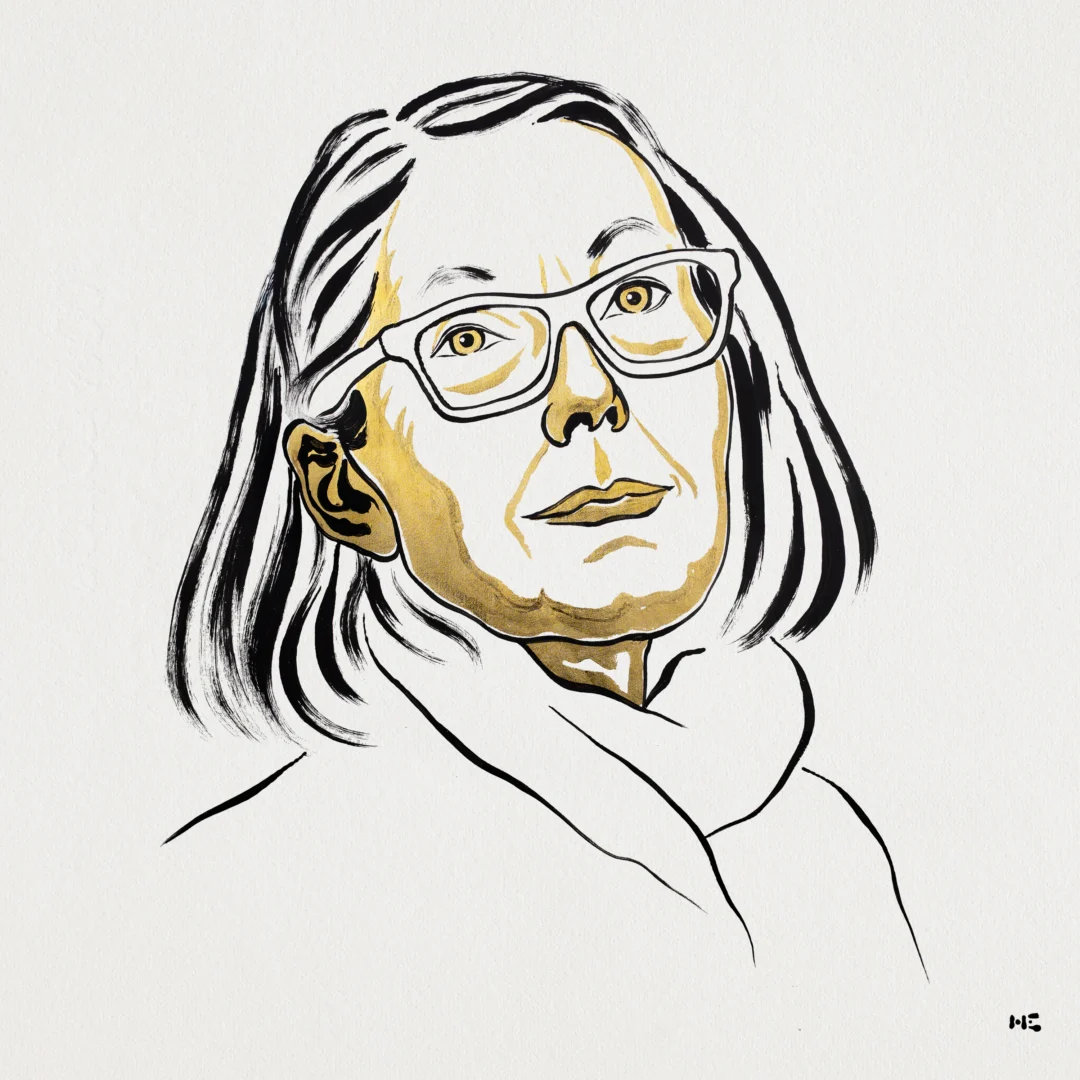
Anne Carson, a Canadian poet and essayist, has won the 2026 Nobel Prize in Literature. The Swedish Academy, which chooses the winner each year, announced the news on Thursday, October 8. Carson is 76 and was born in Toronto. Today she lives in Iceland with her husband, Robert Currie.
When the academy called her, Carson was in Iceland, “listening to the wind,” said Ingrid Carlberg, the academy’s permanent secretary. Carlberg said the call came as a complete surprise to the poet.
Carson taught classics, the study of ancient Greece and Rome, at several universities in North America, and old Greek stories run through much of her writing. Her books are hard to put in one box. A single book can mix poetry, essays, and storytelling, often placing ancient characters next to modern life. Her best-known book, Autobiography of Red (1998), tells a whole story in poems. She has also translated the poems of Sappho, a poet from ancient Greece, into English. The academy praised her “bold and inventive” work.
She is the first Canadian to win the literature prize since short-story writer Alice Munro in 2013. Prime Minister Mark Carney called it “a proud moment for Canada.” The prize comes with 12 million Swedish kronor (about 1.7 million Canadian dollars), and Carson told the academy that she and her husband are “thinking of ways to give the money away.”
The literature prize followed three science prizes earlier in the week. On Monday, the prize in medicine went to Karl Deisseroth of Stanford University in the U.S. and to Peter Hegemann and Georg Nagel, two scientists in Germany. Hegemann and Nagel found a protein in a green alga that works like a tiny door. When blue light shines on it, the door opens and creates a small electrical signal in the cell. Deisseroth then found a way to put that protein into the brain cells of animals, so scientists could switch the cells on and off with light. The method, called optogenetics, shows researchers what each kind of brain cell does. It is now helping them study illnesses such as depression and Alzheimer’s disease.
On Tuesday, Francis Halzen of the University of Wisconsin-Madison won the physics prize for IceCube, a giant detector buried deep in the ice near the South Pole. IceCube looks for neutrinos, tiny particles that pass through almost everything, even our bodies. Some neutrinos travel to Earth from exploding stars and black holes far out in space. On the rare occasions that one hits an atom in the ice, it makes a faint flash of light. IceCube’s sensors spot the flash, so scientists can trace the neutrino back to where it came from and study those distant places in a new way.
On Wednesday, the chemistry prize went to Henri Kagan, who worked at the University of Paris-Sud in France, and Kenso Soai of the Tokyo University of Science in Japan. Many molecules come in two mirror forms, like a left hand and a right hand. In a medicine, one form may help the patient while the other does nothing or causes side effects. Kagan and Soai found ways to make chemical reactions produce mostly one form, which helps companies make medicines that are safer and more precise.
Image: Ill. Niklas Elmehed © Nobel Prize Outreach
Sources: The Associated Press, The Canadian Press, Smithsonian
Anne Carson, the Toronto-born poet, essayist, and translator, has won the 2026 Nobel Prize in Literature. The Swedish Academy announced on Thursday, October 8, that the 76-year-old was being honoured “for her bold and inventive oeuvre that, in playful dialogue with the classical tradition, has created new forms for contemporary literature.”
Carson now lives in Iceland with her husband, Robert Currie. According to Ingrid Carlberg, the academy’s permanent secretary, Carson was out “listening to the wind” when the call came, and the news caught her completely off guard.
A classical scholar by training, Carson taught at universities including McGill and Princeton, and the literature of ancient Greece and Rome runs through nearly everything she writes. Her books refuse to sit in a single genre. Autobiography of Red (1998) is a novel in verse that has sold nearly 100,000 copies in the U.S. Nox (2010) is about her brother, Michael, and Norma Jeane Baker of Troy sets Marilyn Monroe beside Helen of Troy. She has also translated the works of the ancient Greek writers Sappho, Sophocles, and Euripides. Anders Olsson, who chairs the Nobel literature committee, said her work lives where “the philologist’s obsession with words” meets “the poet’s desire for new meaning.”
Carson is the first Canadian literature laureate since Alice Munro in 2013, and only the third Canadian-born writer to win, after Munro and Montreal-born Saul Bellow in 1976. Prime Minister Mark Carney called it “a proud moment for Canada.” The prize carries 12 million Swedish kronor (C$1.7 million), and Carson told the academy that she and her husband are “thinking of ways to give the money away.”
The literature award followed three science prizes earlier in the week. Medicine went to Karl Deisseroth of Stanford University, Peter Hegemann of Humboldt University of Berlin, and Georg Nagel of the University of Würzburg, for optogenetics. Hegemann and Nagel found a protein in a green alga that works like a tiny gate: when blue light hits it, it opens and lets charged particles into the cell, creating an electrical signal. Deisseroth inserted the gene for that protein into the neurons of live animals, so researchers could switch specific brain cells on and off with a beam of light. The technique is now widely used to study conditions such as depression, schizophrenia, and Alzheimer’s disease.
The physics prize went to Francis Halzen of the University of Wisconsin-Madison alone, the first time since 1992 that it has not been shared. Halzen is the driving force behind IceCube, which uses a cubic kilometre of Antarctic ice as a detector for neutrinos, near-massless particles that stream through ordinary matter almost untouched. Some come from exploding stars and black holes. When one does strike an atom deep in the ice, it gives off a faint flash, and IceCube’s 5,160 sensors record it, allowing scientists to trace the most energetic neutrinos back to their source. Mark Pearce, who chairs the physics committee, said Halzen’s work “paved the way for a new kind of astronomy.”
Chemistry was shared by Henri Kagan of the University of Paris-Sud and Kenso Soai of the Tokyo University of Science, who helped explain molecular handedness. Many molecules exist in two mirror-image forms, and in a drug, one form may treat the illness while its twin does nothing or causes side effects. Kagan showed in 1986 that a slightly lopsided catalyst could tip a reaction strongly toward one form. Soai went further, designing reactions that produce their own catalyst, amplifying the bias until almost all of the product is one form. “The medicines we have today would not be possible without this chemistry,” said Rigoberto Hernandez, president of the American Chemical Society.
Image: Ill. Niklas Elmehed © Nobel Prize Outreach
Sources: The Associated Press, The Canadian Press, Smithsonian